.svg)
.svg)
How Parloa made 65 specialist hires in 18 months
Parloa has made 65 hires with Tribe since March 2025. 87 offers went out and 65 were accepted, an acceptance rate of 75%, on engineering roles where the technical bar eliminates most candidates early in the process.
Company introduction
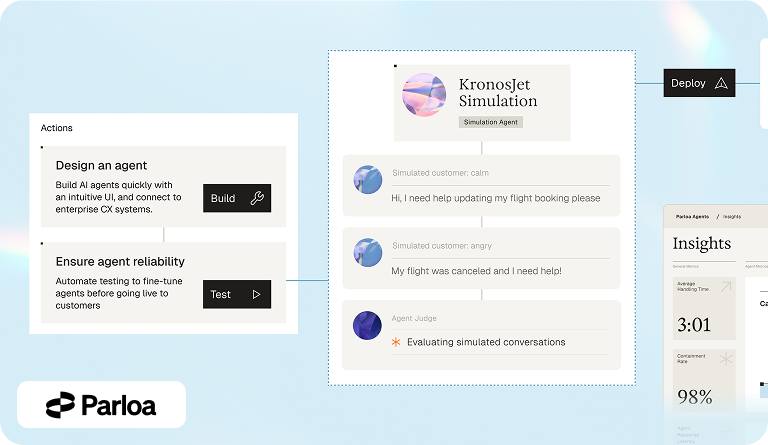
Parloa is an AI company founded in 2018 by Malte Kosub and Stefan Ostwald, with offices in Berlin, Munich, New York and San Francisco. Its AI Agent Management Platform automates contact centres, using AI agents that hold natural conversations with customers and assist human agents when a call is handed over. Global brands use it to handle customer contact at scale.
In May 2025, two months after our work started, Parloa raised $120 million in a Series C round at a $1 billion valuation, which made it one of Germany's few AI unicorns.
Key data
- Project period: data period from March 2025 to August 2026, project ongoing
- Hires: 65
- Offers: 87, an acceptance rate of 75%
- Candidates sourced: 10,380
- Phone screens: 1,685
- Candidates sent to Parloa: 875
- Roles: 99% engineering, mostly senior frontend, backend, Python and staff level
- Team: 1-2 embedded Talent Acquisition Partners, flexing to company needs over time, plus a full-time sourcer; including a US based recruiter added for 8 months when hiring needed local knowledge
Context
Parloa needed senior engineers, including specialised profiles that are hard to find in the European market, and they wanted recruiting capacity they could scale as the company grew. That is why they came to us: our recruiters work inside the team on a flat monthly subscription, and the model gave them sourcing depth on niche roles plus a second opinion on how their talent acquisition function ran.
The hiring managers are selective and the technical bar is high across every role. Response rates on several searches were low. For the most senior and specialised profiles, there were not enough candidates in the pipeline to give hiring managers a real choice.
Needs analysis
Challenges
- Senior engineering profiles that are scarce in the European market, assessed against a demanding coding challenge
- Low candidate response rates on several roles
- A change of leadership in the talent acquisition function partway through the project
- Priorities and role assignments that moved often during the engagement
Opportunities
- Prepare candidates properly for the coding challenge so the assessment tested what it was meant to test
- Give hiring managers market data on where the talent for each role actually is
- Support the incoming talent acquisition lead on process, not only on filling roles
Action plan and implementation
A Tribe Talent Acquisition Partner joined Parloa's team in March 2025, with a Tribe sourcer alongside. A second Talent Acquisition Partner joined in June 2025 and is still with the team. They work in Parloa's tools and own pipelines for senior engineering roles next to the internal recruiters.
The team changed shape as the hiring plan did. When Parloa needed local knowledge for hiring in the US, we added a US based recruiter from November 2025 to June 2026, and took that cost back out when the need passed. Across the engagement the team has averaged two Talent Acquisition Partners and the equivalent of one full-time sourcer.
The first eight months went into building a talent pool and mapping a market that is genuinely small. We sourced 3,850 candidates in that period and sent 206 of them to Parloa. Alongside that we mapped what exists for each niche profile: where those specialists are based, what tech stacks they come from, and how realistic each brief was against the talent actually available in the market.
That map informed which roles Parloa opened, where we searched for each one, and which briefs needed adjusting before the search started.
Two things changed in how candidates moved through the process. We started preparing candidates for the coding challenge before they sat it, so they understood what was being tested and how. We also brought soft skill assessment forward, which gave hiring managers a fuller picture of a candidate before the technical stage.
When the head of talent acquisition left and a new one joined, our recruiters held the pipelines and the context through the handover. They then worked with the new lead to agree priorities and how the function would run.
Results and reflection
65 hires from 87 offers. 75% of the candidates we made offers to accepted them, on roles where senior engineers usually have several other processes running at the same time.
60 of the 65 hires have come in 2026, including 13 in July alone. In 2026 so far, 13 of every 100 candidates we sent to Parloa have received an offer, against 10 across the engagement as a whole. Those hires came out of the talent pool built and mapped in the first year of the project.
More candidates cleared the coding challenge after we introduced preparation ahead of it. The pass rate had been the narrowest point in the process, and prepping candidates on what the challenge tested moved it.
Pipelines stayed consistent through a period when priorities changed frequently and roles were reassigned between recruiters. That continuity mattered most during the talent acquisition leadership handover, when the searches kept running while the function changed hands.
The team scaled up and down with the plan, so what Parloa paid followed the hiring.
Parloa's leadership pointed to their Tribe recruiters as the example of how their own internal recruiters should work. One of them is now a mentor and advisor to Parloa's internal talent acquisition team, coaching them and improving how they hire. For an embedded model that is the outcome worth having: the capability stays in the client's team.
Ready to scale your hiring?
If you are hiring senior engineers against a high technical bar and your pipeline is thin, we can help. Our recruiters embed in your team, work in your tools, and scale up or down as your hiring plan changes. No lock-ins. No hidden fees.




.jpg)
.avif)

.avif)
.svg)
.avif)


.svg)

.svg)

Check our FAQs
.svg)