.svg)
.svg)
Why enterprise hiring is slow (it's not sourcing)

Most enterprise teams assume slow hiring is a sourcing problem. It rarely is.
The real constraint is what happens after candidates enter the funnel. Requirements drift mid-search, stakeholders optimise for different things, interview loops expand without clear purpose, and feedback arrives late or in conflicting formats. These decision-making failures add weeks to every search and cost you candidates who will not wait.
In 2024, 60% of companies reported that their time to hire increased, and the trend is continuing. But the cause is not a shortage of applicants. It is friction inside the process itself.
Where the time actually goes
When you break down a typical enterprise hiring timeline, the biggest delays rarely happen at sourcing. They happen at decision points. Calibration calls get pushed. Interviewers take days to submit feedback. Hiring managers wait for "one more candidate" before making a call. Approvals stack up across multiple levels.
The pattern is consistent: 42% of candidates drop out because scheduling and communication take too long. That means you are not losing people to competitors with better sourcing. You are losing them to competitors who decide faster.
For senior and specialised roles, the problem is worse. These searches often stretch into quarter-plus timelines, leaving leadership gaps and stalling strategic initiatives. When hiring slows at the top, decision-making across the organisation slows with it.
The root cause is alignment, not effort
Slow hiring is usually a symptom of unclear success criteria and distributed accountability. When intake is rushed, interviewers end up evaluating candidates against different standards. When there is no shared scorecard, feedback becomes subjective and harder to reconcile. When no one owns the decision timeline, urgency dissipates.
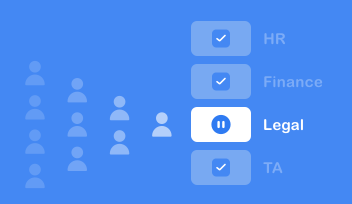
Multiple levels of approval have become a major factor in extended hiring cycles, particularly in enterprise environments where headcount governance has tightened. Companies that once moved quickly now require sign-off from finance, HR, and business leadership before an offer can go out. Each layer adds days, and those days compound.
The fix is not to remove governance. It is to front-load alignment so decisions can move quickly once candidates are in play.
How to recover velocity without sacrificing quality
Speed and quality are not trade-offs. In most cases, the changes that improve velocity also improve hiring outcomes because they force clarity earlier in the process.
Start with intake. Define success criteria, dealbreakers, and evaluation standards before sourcing begins. Lock these into a scorecard that every interviewer uses. This reduces rework and makes calibration faster. Next, establish feedback SLAs. Interviewers should submit structured feedback within 24 hours of each conversation. Late feedback delays decisions and often conflicts with earlier assessments because memory fades.
Run weekly pipeline reviews. These create forcing functions for decisions and surface bottlenecks before they become blockers. Finally, compress approval windows. Pre-align on compensation bands and headcount approval so offers can move within 24 to 48 hours of a final interview.
These are not radical changes. They are operating hygiene. But in enterprise environments where process has accumulated over time, implementing them consistently can cut weeks from your average time to hire.
The bottom line
Slow hiring is rarely a sourcing problem. It is a decision-making problem. Requirements drift, feedback lags, and approvals stack up. Candidates who will not wait end up somewhere else.
If you want to recover velocity, start by mapping where time actually gets lost in your process. Then tighten intake, enforce feedback SLAs, and compress decision windows. Embedded recruiting is one of the most effective ways to remove these bottlenecks. See how it has worked across our case studies, or talk to us about your specific situation. Check our pricing to understand how engagements are structured.
FAQ
What causes slow hiring in enterprise organisations?
The biggest factors are unclear success criteria, inconsistent feedback, multi-layer approvals, and scheduling delays. Sourcing is rarely the bottleneck.
How do I reduce time to hire without lowering the bar?
Front-load alignment through structured intake and scorecards. Faster decisions come from clearer criteria, not lower standards.
What is a good feedback SLA for interviewers?
Aim for structured feedback within 24 hours of each interview. Late feedback delays decisions and reduces accuracy.
Why do candidates drop out of hiring processes?
Slow communication and drawn-out timelines are the top reasons. Candidates interpret delays as disorganisation or lack of interest.
You Might Enjoy




.svg)


.jpg)
.svg)




.svg)
.svg)

.svg)
.svg)


Check our FAQs
.svg)