.svg)
.svg)
Why embedded sourcing outperforms outsourced lists

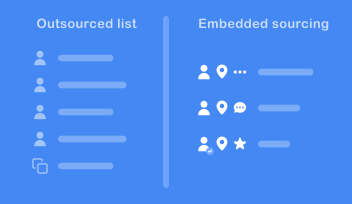
Outsourced sourcing often delivers volume without context. You get a list of names, but no insight into how they were found, why they might be interested, or how the market actually responded to your outreach.
Embedded sourcing works differently. Instead of handing off a spec and waiting for a spreadsheet, you integrate sourcers into your workflow. They use your tools, follow your cadence, and learn what "good" looks like in your environment. The result is not just more candidates. It is better pipeline, faster calibration, and a sourcing function that improves over time.
The problem with outsourced lists
Traditional sourcing vendors operate at a distance. They take a job description, run searches, and return names. But they rarely see what happens next. They do not know which candidates converted, which messages landed, or why certain profiles missed the mark. Without that feedback, they cannot improve.
This disconnect shows up in the numbers. Only 8.5% of outreach emails receive a response, and generic campaigns perform even worse. When sourcing is transactional, there is no mechanism to learn what works. You get activity, but not iteration.
The deeper issue is context. A list of profiles tells you nothing about market depth, compensation expectations, or how your opportunity compares to what candidates are already evaluating. Without that intelligence, hiring teams make decisions based on assumptions rather than data. This is exactly the signal versus volume problem that holds most sourcing functions back.
What embedded sourcing changes
Embedded sourcing closes the feedback loop. Sourcers join your tools and rituals. They see which candidates move forward, which ones drop off, and why. That visibility creates a learning cycle that static outsourcing cannot replicate.
This model also changes the output. Instead of a one-time list, you get calibrated longlists and weekly shortlists based on real market feedback. Sourcers can tell you not just who is available, but what tradeoffs you are making: seniority versus salary, location versus notice period, speed versus specificity.
For hard-to-fill roles, AI-assisted search and personalised outreach can double response rates compared to generic templates. But AI alone is not enough. The advantage comes from combining technology with context, which is what embedded sourcers provide.
When embedded sourcing fits
Embedded sourcing works best when you need more than names. It fits teams that are hiring in competitive markets, filling roles where signal quality matters more than volume, or scaling across multiple searches where calibration needs to stay consistent.
It also fits when priorities shift. Because embedded sourcers operate inside your workflow, they can adjust targeting in real time. If requirements change mid-search, or market feedback suggests a pivot, they adapt without starting over. Companies with structured sourcing programmes fill positions faster and reduce cost per hire significantly compared to teams relying on reactive job postings.
The model is less suited for one-off searches where speed matters more than learning, or roles where inbound volume is already sufficient. In those cases, a transactional approach may be enough.
The bottom line
Outsourced sourcing gives you names. Embedded sourcing gives you a system that learns. When sourcers integrate into your workflow, they accumulate context that improves targeting, sharpens outreach, and builds pipeline that actually converts.
If you want to move beyond static lists, start by defining what "good" looks like for your highest-priority roles. Then bring sourcers close enough to see outcomes, not just inputs. That feedback loop is what turns sourcing from a service into a capability. Pair it with embedded recruiting for end-to-end coverage. See our case studies to understand what this looks like in practice, check our pricing, or talk to us.
FAQ
What is embedded sourcing?
Embedded sourcing integrates sourcers into your team's workflow so they can build qualified pipeline while learning what converts in your specific market.
How is embedded sourcing different from outsourced recruiting?
Outsourced recruiting typically delivers candidate lists without visibility into outcomes. Embedded sourcing operates inside your tools and cadence, with access to feedback that improves targeting over time.
What roles benefit most from embedded sourcing?
Roles in competitive markets, positions where passive candidates are essential, and searches where calibration and market intelligence matter more than raw volume.
How quickly can embedded sourcing ramp up?
Most teams see calibrated shortlists within the first two weeks. The model is designed to start fast and improve as feedback accumulates.
You Might Enjoy





.svg)

.svg)






.jpg)
.svg)
.svg)
.svg)
.svg)


Check our FAQs
.svg)